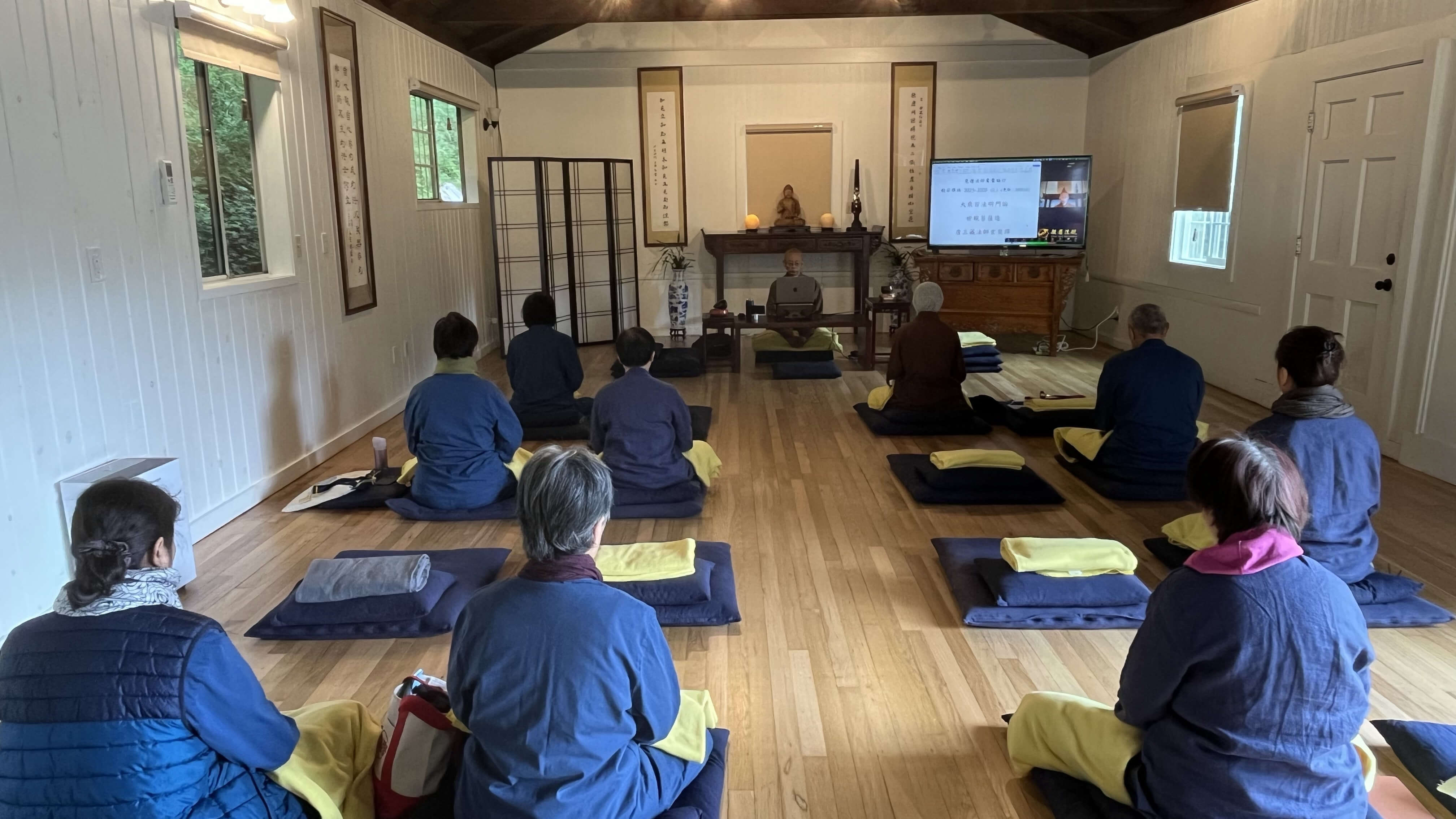
上見護法師《百法明門論》的課時,看到將「無貪、無瞋、無痴、無害……」列為善法,心中一直有個疑惑:
為什麼不是佈施、慈悲、智慧、護念眾生……?佛法,不是在教我們努力行善、培養善法嗎?
這個問題暫且放在心中,幾件小事,卻成了幫助我理解的善緣:
其一,我們的討論小組中,有一位來自科州的傳融師兄。每當大家討論得熱烈,他總是淡淡地說一句:「就放下呀!回歸大海呀!回到覺性呀……」一句話,常讓大家頓時語塞。心裡不免疑問:討論,難道不是一個必要的過程嗎?
其二,前幾天看了一部電影,其中一句台詞,彷彿回應了這個疑問:
“Don’t confuse skepticism with wisdom.”
「不要把懷疑,誤認為智慧。」
於是忽然明白:好辯不是智慧,爭論不是智慧,故作高深,也不是智慧。真正要緊的,是放下,回歸覺性。
其三,又想起魯米(Rumi)的一句話:
“Out beyond ideas of wrongdoing and rightdoing, there is a field. I’ll meet you there.”
「超越對與錯的分別之外,有一片原野,我們在那裡相遇。」
其四,有一張照片,讓我駐足良久。欽佩攝影師的才華之餘,我一直凝視著畫面中那張白色的面具——她正伸出手,準備將它揭下。
課堂種下的種子,似乎在此刻慢慢發芽。
原來,修行,不是換上一張更慈悲、更善良、更有修行的臉,而是回到本來的面目。
我們總在心中想著:我要發心,我要慈悲,我要有智慧,我要利益眾生,我要成為一個有修行的人。
然而,當心中不斷生起一個「我要」,便多了一個「我」;有了「我」,便有了他人,有了好壞分別,也有了自以為是的道德標準。這個「我」,正是一種執取。
於是,「善法」反而可能成為另一張面具,在不知不覺中,被誤認為真正的自己。
《金剛經》說:「應無所住,而生其心。」至此,似乎能稍稍體會,為何《百法明門論》將「無貪、無瞋、無痴、無害」列為善法。它並非要我們在心上再加一層「善」,而是提醒我們,將覆蓋清淨心的染污,一層一層放下。
因此,修行,不是不斷往自己身上增加什麼,而是不斷卸下那些本不屬於自己的東西。
就像照片中的女子。她並不是戴上一張更完美的臉,而只是把遮蔽真相的面具,緩緩揭開。
「但自懷中解垢衣。」
修行,從來不是成為另一個人,也不是努力塑造一個更完美的自己;只是將覆蓋自性的塵垢,一件一件放下。當面具卸下,本來面目,自然現前。
- 傳恆
During Venerable Jianhu’s class on the Treatise on the Hundred Dharmas (Bai Fa Ming Men Lun), I noticed that “non-greed, non-hatred, non-delusion, non-harm…” are listed as wholesome dharmas.
This raised a question in my mind:
Why not generosity, compassion, wisdom, or caring for sentient beings? Isn’t the Dharma teaching us to actively do good and cultivate wholesome qualities?
I held this question quietly, and a few small moments became the conditions that helped me understand.
First, in our discussion group, there is a fellow practitioner, Chuanrong, from Colorado. Whenever our conversations become animated and intense, he gently says, “Just let go. Return to the ocean. Return to awareness…” With a single sentence, everyone falls silent. And yet, I wondered—aren’t discussions also a necessary process?
Second, a few days ago, I watched a film in which a line seemed to respond to this very question:
“Don’t confuse skepticism with wisdom.”
Suddenly, something became clear: being argumentative is not wisdom; debate is not wisdom; appearing profound is not wisdom. What truly matters is letting go and returning to awareness.
Third, I was reminded of a line by Rumi:
“Out beyond ideas of wrongdoing and rightdoing, there is a field. I’ll meet you there.”
Fourth, there was a photograph that held my attention for a long time. Beyond admiring the photographer’s artistry, I found myself drawn to a white mask in the image. A woman was reaching up, about to remove it.
The seed planted in class began, quietly, to sprout.
I came to see that practice is not about putting on a more compassionate, kinder, or more “cultivated” face. It is about returning to one’s original face.
So often, we think: I should generate aspiration. I should be compassionate. I should be wise. I should benefit others. I should become someone who is truly practicing.
Yet each time the thought “I should” arises, another “I” is created. With that “I” comes others, distinctions of good and bad, and self-imposed moral standards. This “I” itself is a form of grasping.
In this way, even “wholesome dharmas” can become another mask—one we unknowingly take to be our true self.
The Diamond Sutra says: “Give rise to the mind without abiding anywhere.”
With this, I begin to understand why the Treatise on the Hundred Dharmas lists non-greed, non-hatred, non-delusion, and non-harm as wholesome dharmas. It is not asking us to add another layer of “goodness” onto the mind. Rather, it reminds us to let go, layer by layer, of the defilements that obscure our pure nature.
Thus, practice is not about adding something to ourselves, but about releasing what was never truly ours to begin with.
Like the woman in the photograph—she is not putting on a more perfect face, but simply removing the mask that conceals what is real.
“Only remove the soiled garments from within.”
Practice has never been about becoming someone else, nor about striving to construct a more perfect self. It is simply letting go, piece by piece, of the dust that covers our true nature. When the mask falls away, our original face naturally reveals itself.